La orientación profesional no empieza en el bachillerato; empieza mucho antes, a menudo moldeada por sesgos y expectativas invisibles que condicionan el futuro de nuestras jóvenes.
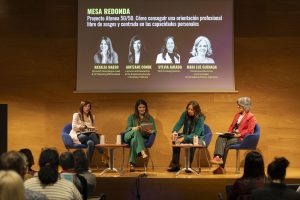
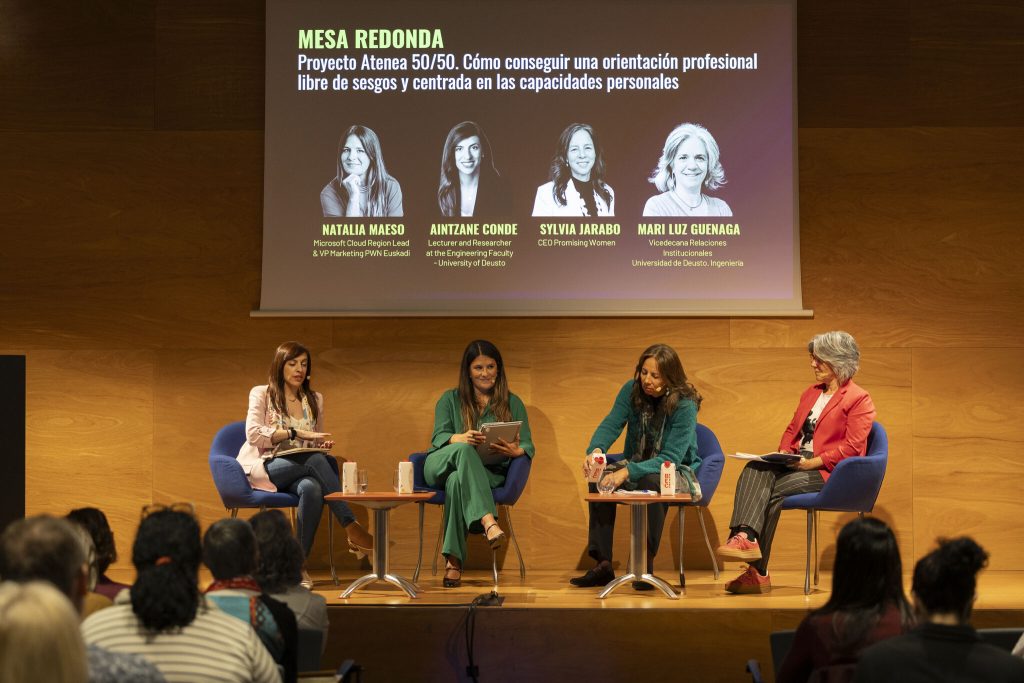
On March 3, I had the opportunity to explore this issue in greater depth during the roundtable discussion titled “Project Athena 50/50: How to Achieve Bias-Free Career Guidance,” held as part of Women in Industry (WIN) at the BIEMH 2026 (Bilbao Exhibition Centre).
This project is not a one-off initiative, but rather the result of more than a year of collaborative work between the School of Engineering at the University of Deusto, the Official Association of Industrial Engineers of Bizkaia (COIIB), and PWN Euskadi.
At the table, I exchanged thoughts with professionals I admire who offer complementary perspectives from the worlds of business and strategic consulting: Natalia Maeso (Microsoft Cloud Region Lead), Sylvia Jarabo (CEO of Promising Women), and Aintzane Conde-Fernández (a colleague at Deusto and a key researcher on the project).
During the discussion, we highlighted some of the most compelling findings from the Atenea 50/50 Project, which I believe are important for any organization or family:
- The decisive influence of family: Expectations from one’s immediate circle remain the number one factor in career choice. Unless we educate families, we’ll have a hard time changing the statistics in engineering.
- AI as an ally, not a barrier: We have developed AI-based tools specifically designed to identify and reduce bias in career guidance. When used wisely, technology is a powerful antidote to human prejudice.
- Capcities vs. Stereotypes: The ultimate goal is for every young person to choose their own path based on their true talents and personal skills, eliminating the gender-based “noise” that still persists in the industry.
Participating in forums like WIN (Women in Industry) is essential because it allows us to challenge organizations to set measurable and ambitious goals. The industry of the future will be diverse and equitable, or it simply won’t be competitive.
I would like to thank PWN Euskadi for creating this much-needed forum for discussion, and everyone who came to the BEC to share this vision of a more inclusive engineering field.